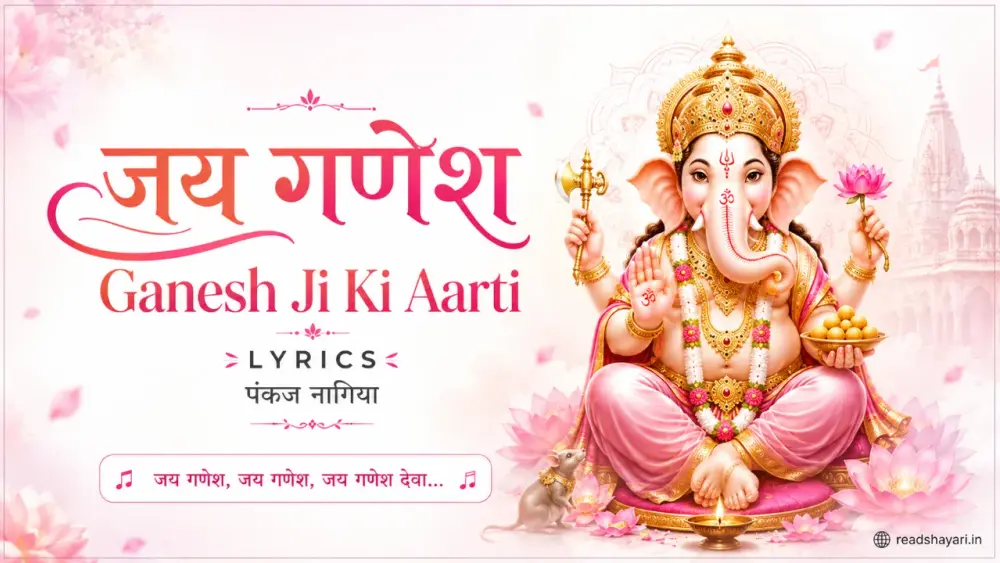
जय गणेश, जय गणेश, जय गणेश देवा… If there is one prayer that resonates in almost every Hindu household at the beginning of any auspicious work, puja, or festival, it is the beautiful Ganesh Ji Ki Aarti. Lord Ganesha, also known as Vighnaharta (the remover of obstacles) and Mangalkarta (the bringer of auspiciousness), is always worshipped first. Among the various versions available today, the rendition sung by the renowned devotional singer Pankaj Nagia stands out for its traditional rhythm and peaceful composition.
Released under the prestigious T-Series Bhakti Sagar label and composed by music director Rohit Kumar Bobby, Pankaj Nagia’s version of the aarti brings a sense of deep serenity and devotion. His melodious voice makes it easy for devotees of all age groups to sing along during morning and evening prayers or major celebrations like Ganesh Chaturthi.
In this article, you will find the complete, verified Ganesh Ji Ki Aarti lyrics in Hindi (गणेश जी की आरती) and its English transliteration. We have also detailed the musical credits, explained the spiritual meaning behind the verses, and compiled a step-by-step guide on how to perform the aarti correctly at home.
Ganesh Ji Ki Aarti Credits & Song Info
To appreciate the musical creation of this popular bhajan, let us look at the official credits of Pankaj Nagia’s version.
| Detail | Information |
|---|---|
| Song Name | Ganesh Ji Ki Aarti (Jai Ganesh Deva) |
| Singer | Pankaj Nagia |
| Music Composer/Director | Rohit Kumar Bobby |
| Lyrics | Traditional Devotional |
| Music Label | T-Series Bhakti Sagar |
| Album/Release | Ganesh Ji Ki Aarti |
| Language | Hindi (Devotional Sanskrit-mixed Hindi) |
| Deity | Lord Ganesha (Vighnaharta) |
| Primary Theme | Surrender, Obstacle Removal, Prosperity, Auspiciousness |
Ganesh Ji Ki Aarti Lyrics in Hindi (गणेश जी की आरती)
Below are the complete, verified lyrics of the Ganesh Ji Ki Aarti in Hindi as sung by Pankaj Nagia. Sing along to invoke the positive energies of Lord Ganesha in your life.
जय गणेश, जय गणेश, जय गणेश देवा।
माता जाकी पार्वती, पिता महादेवा॥
जय गणेश, जय गणेश, जय गणेश देवा।
॥ पहला अंतरा ॥
एकदन्त, दयावन्त, चार भुजाधारी।
मस्तक सिन्दूर सोहे, मूसे की सवारी॥
जय गणेश, जय गणेश, जय गणेश देवा॥
॥ दूसरा अंतरा ॥
पान चढ़े, फूल चढ़े, और चढ़े मेवा।
लड्डुअन का भोग लगे, सन्त करें सेवा॥
जय गणेश, जय गणेश, जय गणेश देवा॥
॥ तीसरा अंतरा ॥
अन्धे को आँख देत, कोढ़िन को काया।
बाँझ को पुत्र देत, निर्धन को माया॥
जय गणेश, जय गणेश, जय गणेश देवा॥
॥ चौथा अंतरा ॥
सूर श्याम शरण आए, सफल कीजे सेवा।
माता जाकी पार्वती, पिता महादेवा॥
जय गणेश, जय गणेश, जय गणेश देवा॥
॥ पांचवा अंतरा ॥
दीनन की लाज रखो, शम्भू सुतवारी।
कामना को पूर्ण करो, जग बलिहारी॥
जय गणेश, जय गणेश, जय गणेश देवा॥
Ganesh Ji Ki Aarti Lyrics in English (Transliteration)
For global devotees and those who prefer reading the lyrics in the Roman script, here is the complete transliteration of Ganesh Ji Ki Aarti in English.
|| Sthayi || Jai Ganesh, Jai Ganesh, Jai Ganesh Deva Mata Jaki Parvati, Pita Mahadeva. Jai Ganesh, Jai Ganesh, Jai Ganesh Deva.
|| Antara 1 || Ekdant, Dayavant, Chaar Bhuja Dhaari Mastak Sindoor Sohe, Moose Ki Sawari. Jai Ganesh, Jai Ganesh, Jai Ganesh Deva.
|| Antara 2 || Paan Chadhe, Phool Chadhe, Aur Chadhe Mewa Ladduan Ka Bhog Lage, Sant Karein Sewa. Jai Ganesh, Jai Ganesh, Jai Ganesh Deva.
|| Antara 3 || Andhan Ko Aankh Det, Kodhin Ko Kaaya Banjh Ko Putra Det, Nirdhan Ko Maaya. Jai Ganesh, Jai Ganesh, Jai Ganesh Deva.
|| Antara 4 || ‘Sur’ Shyam Sharan Aaye, Safal Kije Sewa Mata Jaki Parvati, Pita Mahadeva. Jai Ganesh, Jai Ganesh, Jai Ganesh Deva.
|| Antara 5 || Deenan Ki Laaj Rakho, Shambhu Sutvaari Kamna Ko Poorna Karo, Jag Balihari. Jai Ganesh, Jai Ganesh, Jai Ganesh Deva.
Spiritual Meaning and Significance of Ganesh Aarti
To recite the aarti with true devotion, one must understand the profound spiritual meaning behind each verse. The lyrics are not just praises but are deep psychological and spiritual affirmations.
1. “Jai Ganesh Deva… Mata Jaki Parvati Pita Mahadeva”
- Meaning: We praise Lord Ganesha, the divine deity. He is the son of Mother Parvati (representing nature, energy, and strength) and Father Mahadeva (Lord Shiva, representing consciousness, eternity, and destroyer of ego). By chanting this, we acknowledge the balance of divine feminine (Shakti) and masculine (Shiva) energies in the universe.
2. “Ekdant Dayavant, Chaar Bhuja Dhaari, Mastak Sindoor Sohe…”
- Meaning: Ganesha has a single tusk ( Ekdant), symbolizing single-pointed focus and wisdom. He is compassionate ( Dayavant) and holds four arms ( Chaar Bhuja Dhaari), representing the four directions and his control over the mind, intellect, ego, and conscience. The vermillion ( Sindoor) on his forehead represents protection and vitality, while his mount, the mouse ( Mooshak), represents controlling desire and greed.
3. “Paan Chadhe, Phool Chadhe, Aur Chadhe Mewa…”
- Meaning: We offer Ganesha betel leaves ( Paan), fresh flowers, dried fruits ( Mewa), and his favorite sweet, Modak or Laddu. The sages and saints ( Sant) perform service ( Sewa) to him. Symbolically, offering sweet foods represents dedicating our sweet thoughts, acts of service, and pure speech to the divine.
4. “Andhan Ko Aankh Det, Kodhin Ko Kaaya…”
- Meaning: Lord Ganesha is the ultimate healer and provider. He restores sight to the blind (spiritual blindness), gives a healthy body to the diseased, blesses the childless with children, and grants wealth and resourcefulness to the poor. It affirms that true surrender to Ganesha helps overcome physical, financial, and emotional shortcomings.
How to Perform Ganesh Aarti: Step-by-Step Vidhi & Rules
Performing the aarti correctly helps channelize positive spiritual energies in your home. Here is the step-by-step vidhi and rules based on Vedic traditions.
- Cleanliness & Preparation: Before beginning the aarti, clean the altar (mandir) and take a bath. Wear clean clothes. Sit or stand facing East or North.
- Setting the Diya (Aarti Lamp): Use a brass or silver plate. Place a ghee lamp (diya) with cotton wicks in the center. You may also use camphor (kapoor) for aarti.
- Offerings: Keep some fresh yellow or red flowers (durva grass is highly dear to Lord Ganesha), a plate of sweets (laddus or modak), and water nearby.
- Circulation Direction: Hold the aarti plate and gently rotate it in a clockwise direction in front of the Ganesha idol. The movement should describe the shape of the symbol Om (ॐ) or a full circle, starting from Ganesha’s feet, rising up to the face, and down again.
- Aarti Posture: Stand with a straight back and deep reverence. Ring a small bell with your left hand while rotating the aarti plate with your right hand.
- Accepting the Blessings: Once the aarti is complete, wave your hands over the flame and touch them to your forehead and eyes to receive the warmth and divine energy of the flame.
Frequently Asked Questions (FAQs)
Here are the most common questions devotees ask about Pankaj Nagia’s version of the Ganesh Ji Ki Aarti.
1. Who is the singer of the T-Series Ganesh Ji Ki Aarti?
The highly popular version of the Ganesh Aarti featured on T-Series Bhakti Sagar is sung by the well-known devotional singer Pankaj Nagia.
2. Who composed the music for Pankaj Nagia's Ganesh Aarti?
The music for this beautiful rendition was directed and composed by Rohit Kumar Bobby.
3. Why is Lord Ganesha called 'Ekdant' in the lyrics?
The word Ekdant translates to 'one-tusked'. According to mythology, Lord Ganesha broke his own tusk to write the epic Mahabharata, symbolizing self-sacrifice for knowledge and a single-pointed focus on intellectual tasks.
4. What are the best offerings to make during Ganesh Aarti?
Lord Ganesha is traditionally offered Durva grass (three-bladed grass), yellow marigold flowers, hibiscus flowers, betel leaves (Paan), coconut, and his favorite sweets— Laddus or Modaks.
5. At what times should we recite Ganesh Ji Ki Aarti?
While the aarti can be recited at any time, it is traditionally performed twice a day—during sunrise (morning prayers) and sunset (evening prayers) to keep the house filled with positive vibrations.
Conclusion
Pankaj Nagia’s rendition of the Ganesh Ji Ki Aarti provides a perfect balance of traditional devotion and modern acoustic clarity. Chanting these sacred verses regularly helps foster a focused mind, positive environment, and spiritual grounding. Integrating this practice into your daily morning or evening rituals creates a serene space that welcomes clarity and removes intellectual and emotional blocks.